 English
  Spain
Spain  Deutsch
 GET A QUOTE


Palletized transport is an efficient logistics approach widely adopted by scaling enterprises. As daily shipping throughput increases, integrating forklifts and palletized handling systems becomes essential for maintaining high operational capacity. Whether managing standard warehousing or large-scale distribution, utilizing structured pallet transport optimizes material movement across the entire supply chain.
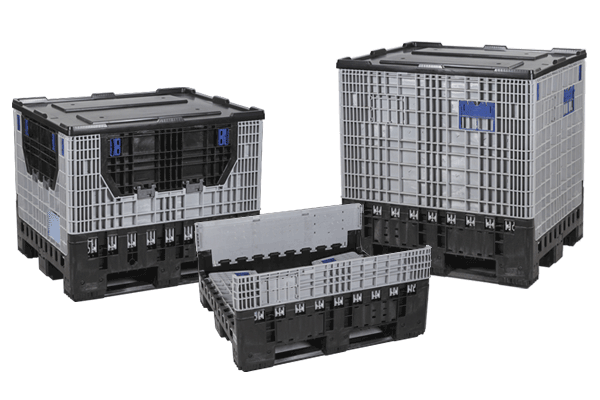
When transitioning to palletized freight, procurement managers must determine whether standard plastic pallets or bulk pallet containers best align with their operational needs. Although both solutions serve to consolidate and transport goods, their ideal applications depend heavily on product types and handling environments.
In most cases, combining standard plastic pallets with strapping bands and stretch film handles the bulk of transport and turnover needs. This approach works exceptionally well for uniformly packaged or regularly shaped items that can be stacked directly. For example, collapsible produce crates are flat and uniform; for bulk shipments, they simply need to be collapsed, stacked on plastic pallets, and wrapped with stretch film. Similarly, in the food industry, finished goods that are already boxed in cartons can be secured to pallets using strapping bands. In short, pre-packaged finished goods are ideally suited for standard plastic pallet transport.
However, some manufacturers prefer to bypass outer cardboard cartons altogether, especially when handling raw materials or component parts rather than finished goods. For instance, plastic bottles and caps transported to bottling plants are often bagged in bulk. Packaging them in cartons before placing them on pallets creates unnecessary single-use waste. Yet, placing loose, irregularly stacked items directly onto flat pallets invites tipping and cargo spillages. In these scenarios, large plastic pallet containers or sleeve packs are the ideal solution. They remain fully forklift-compatible while providing enclosed structural support and stability to prevent falling.
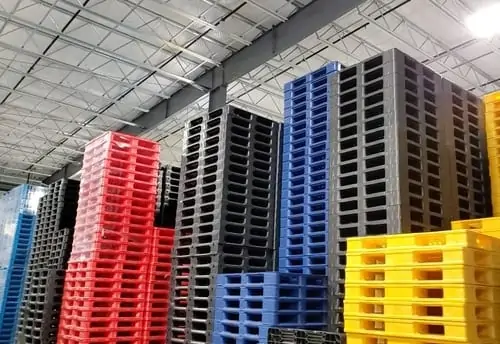
The operating environment plays a vital role in determining suitable industrial packaging. Internal facility handling and external distribution represent two distinct operating conditions. Compared to external transit, containers used exclusively for internal plant operations undergo structured management, leading to minimal wear and tear. However, internal applications often demand strict hygiene standards and cleanable materials. Additionally, storage methods must be evaluated, including high-bay racking support, moisture resistance, fire safety, and static protection. These operational requirements ultimately determine the ideal material specifications for pallets and bulk containers.
Dimensions and sizing constraints also determine whether to opt for standard pallets or bulk pallet boxes. Although collapsible sleeve packs come in a wide range of custom sizes, certain extreme dimensions remain unfeasible. Plastic pallets offer even less sizing flexibility due to national and international standardization, with 1200x1000 mm being the predominant standard logistics size. For applications requiring non-standard footprint dimensions, standard plastic pallets may not suffice, necessitating specialized container configurations.
At MEEYA PACK, we provide comprehensive industrial packaging solutions, including heavy-duty plastic pallet boxes, collapsible plastic crates, returnable sleeve packs, and high-performance plastic pallets.