 English
 Spain
 Deutsch
 GET A QUOTE


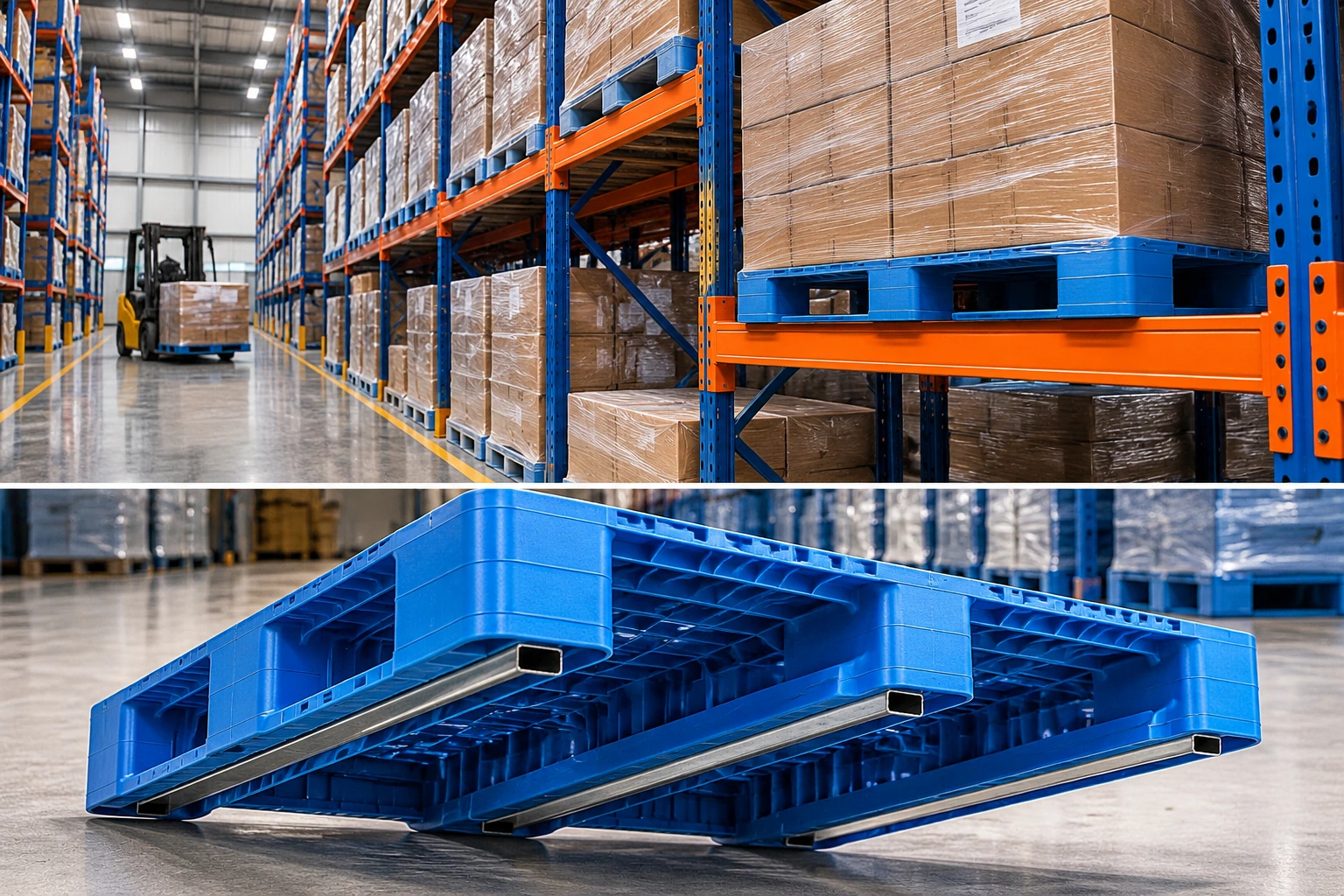
The difference comes down to how the pallet is supported, how the load is distributed, and how the pallet is designed to handle bending under weight.
For warehouse operators, logistics companies and industrial buyers, choosing the wrong pallet can lead to excessive deflection, unstable loads, damaged products and potential safety risks.
In this guide, we'll explain what to look for when buying rackable plastic pallets, how static, dynamic and racking load capacities differ, and when steel reinforcement is worth considering.
A rackable plastic pallet is designed to support a loaded unit while resting on warehouse racking beams, rather than being fully supported by the floor.
Unlike floor storage, where the pallet base receives relatively broad support, a pallet on selective racking may be supported mainly at two opposite edges. The unsupported middle section must resist bending under the weight of the goods.
This makes rackability a structural requirement, not simply a feature of pallet size or material.
Common applications include:
Distribution centers and logistics warehouses
Manufacturing and assembly facilities
Food and beverage storage
Automotive parts warehouses
High-bay storage facilities
Industrial supply chain operations
Not every plastic pallet is suitable for racking. Lightweight export pallets and nestable pallets, for example, should not be assumed to have rack load capacity unless the manufacturer provides an applicable rating.
This is one of the most important things to understand before purchasing plastic pallets.
Manufacturers generally provide three different load ratings.
Load Type |
Meaning |
Typical Application |
|---|---|---|
| Static Load | Maximum load when the pallet is stationary on a flat, solid surface | Floor storage and stacking |
| Dynamic Load | Maximum load while the pallet is being lifted and moved | Forklift and pallet truck operations |
| Racking Load | Maximum load when the pallet is supported by warehouse rack beams | Warehouse racking |
These ratings describe different operating conditions. They cannot be used interchangeably.
For example, a pallet advertised with a static capacity of 4,000 kg does not automatically mean it can support 4,000 kg on warehouse racking.
The racking load rating is the figure buyers should pay particular attention to when selecting pallets for beam-supported storage.
It is also important to confirm whether the stated rating applies to evenly distributed loads, what beam spacing was used, and whether the pallet was tested with or without additional support.
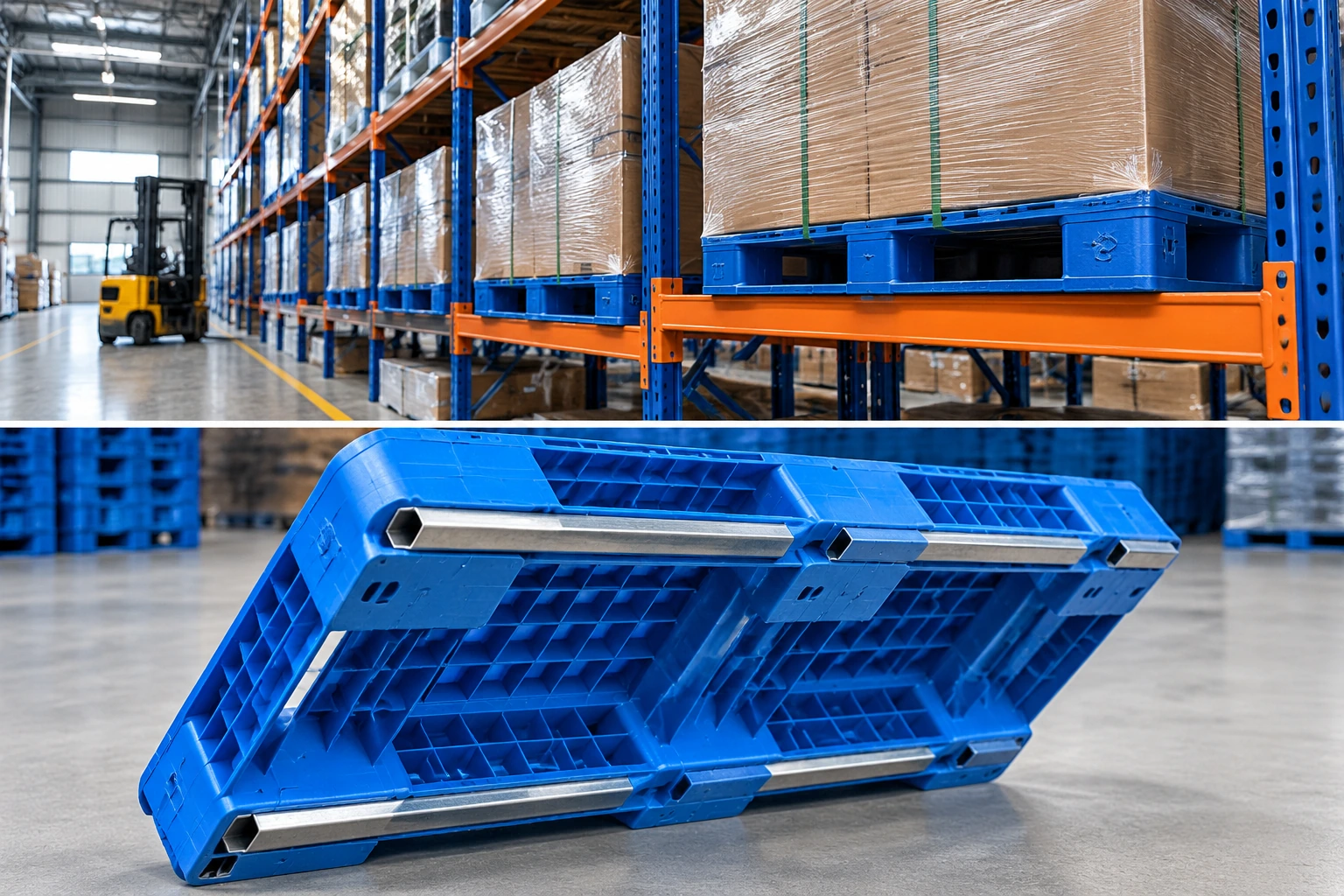
Steel reinforcement is commonly used in heavy-duty plastic pallet designs to improve structural performance.
Plastic provides the main molded structure, while integrated steel tubes or profiles can help improve stiffness and reduce bending under load.
Depending on the pallet design, reinforcement can be incorporated into:
The longitudinal runners
The pallet's underside structure
Specific load-bearing sections
Multiple support channels
Steel-reinforced plastic pallets can be particularly useful in warehouses where loaded pallets are regularly stored on racking.
However, adding steel tubes does not automatically guarantee a particular racking capacity.
The final performance depends on several factors:
Pallet structure: The number, position and dimensions of the runners affect how the load is transferred.
Steel reinforcement: Tube dimensions, wall thickness, material and positioning influence structural performance.
Beam spacing: A wider unsupported span can increase bending.
Load distribution: Concentrated loads may create different stresses from evenly distributed loads.
Operating conditions: Temperature, loading duration and repeated handling can affect long-term performance.
For this reason, buyers should request model-specific technical specifications and supporting load test information rather than relying on general statements about steel reinforcement.
Before requesting a quotation, buyers should understand the actual weight and storage conditions of their unit loads.
Here are five questions worth answering.
1. What is the maximum weight of one loaded pallet?
Calculate the total weight of the products, cartons, packaging and any other materials placed on the pallet.
2. What type of racking system do you use?
Selective pallet racking, drive-in racking and other warehouse systems can have different support arrangements.
3. What is the distance between the rack beams?
The unsupported span directly affects the structural demands placed on the pallet.
4. Is the load evenly distributed?
A concentrated load in the middle of a pallet can behave differently from a uniformly distributed load.
5. How long will the pallet remain on the rack?
Long-term loading can introduce additional deformation considerations. A short-duration load test should not automatically be interpreted as proof of suitability for every long-term storage condition.
A good purchasing decision starts with these operating details, not just a number printed in a product catalogue.
Different plastic pallet structures are intended for different applications.
Pallet Design |
Main Characteristics |
Typical Application |
|---|---|---|
| Nine-leg pallet | Lightweight, often nestable | Export and one-way transportation |
| Three-runner pallet | Continuous support runners | General warehouse handling |
| Six-runner pallet | Multiple supporting runners | Heavy-duty storage and handling |
| Steel-reinforced pallet | Integrated metal reinforcement | Applications requiring additional structural stiffness |
| Double-sided flat deck pallet | Flat surfaces on both sides | Reusable industrial handling and storage |
The best design depends on your warehouse equipment, load requirements, storage method and handling frequency.
A double-sided pallet, for example, may be useful for particular handling and storage requirements, but its suitability for racking must still be confirmed through its specific design and load rating.
Before placing a bulk order, we recommend checking the following information with your supplier.
Item |
What to Confirm |
|---|---|
| Dimensions | Length, width and height |
| Material | HDPE, PP or specified material blend |
| Pallet weight | Actual product weight |
| Static load | Rated capacity under floor-supported conditions |
| Dynamic load | Rated capacity during handling |
| Racking load | Rated capacity under the specified beam-support conditions |
| Reinforcement | Number, dimensions and position of steel tubes |
| Forklift entry | Two-way or four-way entry |
| Deck design | Open deck, closed deck or double-sided |
| Operating temperature | Recommended working temperature range |
| Test documentation | Applicable load test results and test conditions |
One additional point is worth mentioning: a pallet's rated capacity and a warehouse rack's rated capacity are two separate things.
Even when a pallet is suitable for racking, the complete storage arrangement must also comply with the rack manufacturer's loading limits.
The pallet, rack beams, rack configuration, load and handling equipment must work together safely.
We regularly see several issues that buyers should avoid.
Mistake 1: Choosing a pallet based only on static load.
Static capacity does not establish suitability for beam-supported storage.
Mistake 2: Assuming all steel-reinforced pallets have the same performance.
Different tube configurations and molded structures can produce significantly different results.
Mistake 3: Ignoring rack beam spacing.
A pallet tested under one support span may not perform identically under another.
Mistake 4: Comparing products by dimensions alone.
Two pallets measuring 1200 × 1000 mm can have completely different structural designs and load ratings.
Mistake 5: Not requesting technical documentation.
A supplier should be able to explain the conditions behind its advertised load ratings.
Taking time to verify these details before purchasing can help avoid costly mistakes later.
At MeeyaPack, we focus on reusable industrial plastic packaging solutions, including plastic pallets, collapsible sleeve packs and large reusable plastic containers.
For customers looking for heavy-duty plastic pallets, we can discuss different pallet structures, dimensions, materials and steel reinforcement options according to the intended application.
We understand that a distributor purchasing pallets for resale may have different requirements from a warehouse operator looking for a long-term storage solution.
Rather than recommending the same pallet for every application, we prefer to understand the actual requirements first.
If you are sourcing rackable plastic pallets, you can share the following information with our team:
Required pallet dimensions
Maximum loaded weight
Racking system and beam spacing
Preferred pallet structure
Estimated order quantity
Destination country
Our team can then discuss suitable product options and the relevant technical specifications.
Visit MeeyaPack to learn more about our industrial plastic packaging solutions.
No. Only pallets designed and rated for the relevant racking conditions should be used on warehouse beams. A standard nestable or export pallet should not be assumed to be rackable.
Static load refers to the maximum load supported when a pallet rests on a flat, solid surface. Racking load refers to the maximum load supported when the pallet rests on warehouse rack beams, typically with an unsupported central span.
Steel reinforcement can improve structural stiffness and load-bearing performance. However, actual performance depends on the pallet's molded structure, steel configuration and testing conditions.
There is no universal figure. Capacity varies by model, dimensions, material, reinforcement, beam spacing and load distribution. Always check the manufacturer's technical datasheet.
Both materials can be used in industrial pallet designs. The better choice depends on the specific formulation, structure, operating temperature, load requirements and intended service conditions.
Common industrial sizes include 1200 × 1000 mm and 1200 × 800 mm. However, the correct size must match the warehouse rack dimensions, beam positions and handling equipment.
Many industrial plastic pallets are designed for forklift handling. Buyers should confirm the entry configuration, fork dimensions and rated dynamic capacity before ordering.
They should be inspected regularly for visible cracks, deformation, damage to the runners and any exposed or displaced reinforcement. Damaged pallets should be removed from service until assessed.
Certain plastic pallet designs are suitable for food-related warehouse environments because they can be non-porous and easier to clean. However, food-contact suitability must be confirmed through the relevant material and product documentation.
Provide your required dimensions, load capacity, pallet quantity, warehouse application, racking details and destination country. These details help the supplier identify a suitable model and provide a more accurate quotation.
Looking for a reliable plastic pallet supplier?
Whether you need standard industrial pallets or steel-reinforced rackable plastic pallets, MeeyaPack is ready to discuss your requirements.
Tell us your pallet size, load capacity and application, and we'll help you explore suitable options.
MeeyaPack — Packaging Solutions. Engineer Efficiency, Reduce Costs.