 English
 Spain
 Deutsch
 GET A QUOTE


Choosing a plastic pallet involves more than comparing dimensions, weight, and price. A pallet is part of a larger material-handling system, and its performance depends on the products it carries, the equipment used to move it, and the conditions under which it operates.
For manufacturers, warehouses, logistics providers, and international buyers, selecting the wrong pallet can lead to damaged goods, handling delays, unnecessary replacement costs, and operational inefficiencies.
This guide answers 12 frequently asked questions to help buyers evaluate plastic pallets based on actual operating requirements.
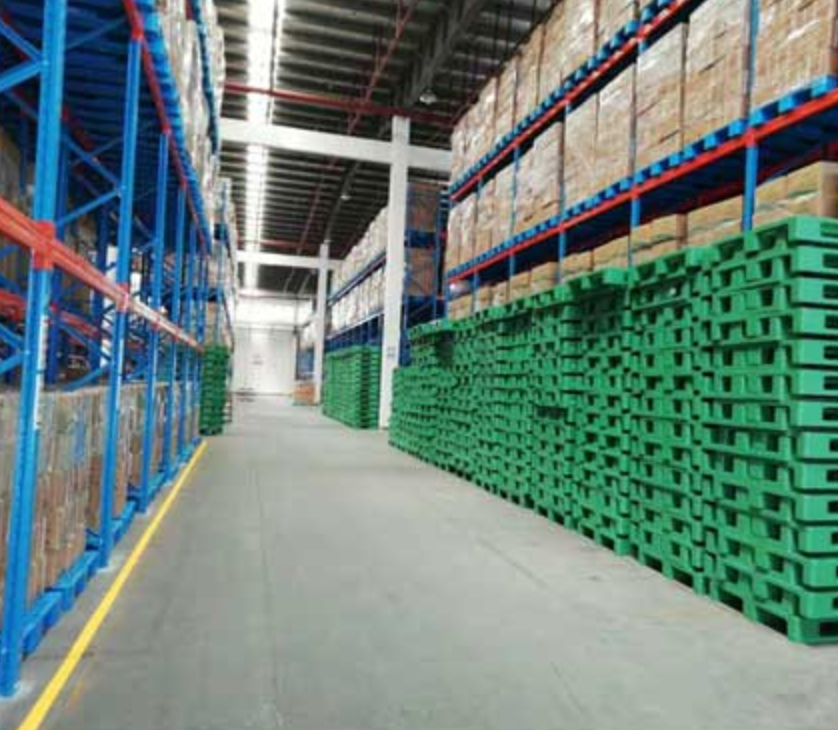
Start with the application rather than the pallet specification.
Before selecting a pallet, identify:
The dimensions and total weight of the goods
Whether the pallet will be used for storage, transportation, or both
Whether forklifts, pallet jacks, conveyors, or automated systems will handle it
Whether pallets will be stored on warehouse racks
The operating temperature and environmental conditions
Whether the pallet will be used once or repeatedly
The destination market and any relevant customer requirements
A pallet that performs well during floor storage may not be suitable for unsupported warehouse racking.
Key takeaway: Define the operating conditions first, then choose a pallet that meets those requirements.
These three load ratings describe different operating conditions.
Static load capacity refers to the load a pallet can support while stationary under specified support and loading conditions.
Dynamic load capacity refers to the load a pallet can carry while being moved, usually by suitable material-handling equipment.
Racking load capacity refers to the load a pallet can support when stored on a rack under a specified support arrangement.
These ratings are not interchangeable.
For example, a pallet rated for a 4,000 kg static load should not automatically be assumed suitable for carrying 4,000 kg on warehouse racks.
Actual performance depends on load distribution, support span, temperature, duration, and the pallet's structural design.
Key takeaway: Always confirm load ratings under conditions that match your operation.
Both HDPE (high-density polyethylene) and PP (polypropylene) are widely used in industrial plastic pallets.
HDPE is commonly selected where impact resistance and low-temperature performance are important.
PP can offer advantages in stiffness and certain operating environments, depending on its formulation.
However, material selection cannot be based on resin type alone.
Pallet geometry, wall thickness, reinforcement, manufacturing quality, recycled material content, and operating temperature can all influence performance.
Key takeaway: Evaluate the finished pallet and its test conditions, not just the material name.
Nestable pallets are designed so that empty pallets can fit partially inside one another, reducing empty storage volume and potentially lowering return transportation costs.
Stackable pallets are designed to be placed on top of one another, although the permissible configuration and load depend on the pallet design.
The choice depends on how the pallets circulate through your supply chain.
If empty pallets frequently return to a distribution center, nestable designs may reduce reverse-logistics costs.
If pallets need a more stable base for repeated handling or particular storage arrangements, other designs may be more appropriate.
Key takeaway: Consider both loaded and empty pallet movements before selecting a structure.
No.
Rack suitability depends on the pallet's structural design, support arrangement, load distribution, and tested performance.
Some plastic pallets are designed primarily for floor storage or transportation and should not be used on open-beam racks without appropriate support.
Even a pallet marketed as heavy-duty may not have a verified racking load rating.
Buyers should confirm:
The rack support configuration
The distance between support beams
The load distribution
The expected storage duration
The relevant operating temperature
Whether additional support is required
Key takeaway: Never assume that a high static load rating guarantees rack compatibility.
Neither material is universally better.
Plastic pallets may offer advantages in cleaning, moisture resistance, dimensional consistency, and repeated use.
Wooden pallets may offer a lower initial purchase cost and can be practical for certain one-way shipments.
The appropriate choice depends on the complete operating system.
For example, a reusable plastic pallet may provide economic value when it completes many cycles with limited loss or damage.
However, a higher-priced reusable pallet may be uneconomical if it is routinely shipped to customers and never returned.
Key takeaway: Compare total lifecycle cost rather than purchase price alone.
Yes. Plastic pallets are widely used for international transportation.
Plastic pallets made entirely from plastic are generally outside the scope of the ISPM 15 wood-packaging treatment requirements.
This can simplify certain export packaging procedures compared with regulated solid-wood packaging.
However, ISPM 15 exemption does not mean a pallet is automatically accepted for every shipment or application.
Importers should still confirm destination requirements, cargo-handling conditions, hygiene expectations, and any applicable industry-specific rules.
Key takeaway: Plastic pallets can simplify export packaging, but shipment suitability still needs verification.
Plastic pallets can be suitable for food and pharmaceutical logistics, but not every plastic pallet is automatically food-contact compliant or suitable for controlled environments.
Requirements depend on whether the pallet directly contacts the product, the operating environment, cleaning procedures, and relevant regulations or customer standards.
For hygiene-sensitive applications, buyers may consider smooth surfaces, accessible cleaning areas, and appropriate material documentation.
Key takeaway: Request application-specific compliance evidence instead of relying only on claims such as “food-grade” or “hygienic.”
There is no universal lifespan for plastic pallets.
Service life depends on:
Frequency of handling
Load conditions
Forklift impact
Operating temperature
UV exposure
Cleaning chemicals
Storage methods
Pallet design and material quality
A pallet in a controlled closed-loop system may experience very different wear from one used in intensive outdoor logistics.
For procurement planning, the useful question is not simply how many years a pallet lasts, but how many successful handling cycles it can complete under defined conditions.
Key takeaway: Evaluate expected service cycles and replacement frequency, not an unsupported lifespan claim.
A useful starting point is:
Total lifecycle cost = Purchase cost + Transportation + Storage + Handling + Cleaning + Repair or replacement + Losses − Residual value
The cost per successful use can then be estimated by dividing the lifecycle cost by the number of completed useful cycles.
For example, a more expensive pallet may have a lower cost per use if it survives substantially more cycles and is consistently recovered.
But this advantage can disappear when pallets are lost, damaged, or returned at excessive cost.
Key takeaway: The pallet recovery rate and actual number of useful cycles can matter more than the initial price difference.
Many plastic pallet suppliers offer customization options, depending on the product design and production process.
Possible options include:
Color
Logo or identification markings
RFID or barcode integration
Material formulation
Reinforcement options
Specific dimensions or structural features
However, not every modification can be made using an existing mold.
Changes to the pallet's main dimensions or structural geometry may require new tooling, which affects minimum order quantity, cost, and lead time.
Key takeaway: Distinguish between customization available with existing tooling and changes requiring a new mold.
A useful quotation request should include:
Required pallet dimensions
Product weight and load distribution
Static, dynamic, and racking requirements, if applicable
Intended use and handling equipment
Material or hygiene requirements
Expected order quantity
Destination country or delivery location
Any special requirements, such as color, logo, or identification
Providing these details helps suppliers recommend suitable products and reduces the risk of comparing quotations for pallets that are not technically equivalent.
The best plastic pallet is not necessarily the strongest, lightest, or cheapest.
It is the pallet that meets the required handling and storage conditions at an acceptable total cost.
A good selection process starts with actual loads, equipment compatibility, operating conditions, and expected reuse cycles. It then verifies product performance before comparing prices.
At MeeyaPack, we help international buyers evaluate plastic pallet options based on their packaging and logistics requirements.
If you are sourcing plastic pallets for warehousing, manufacturing, export shipping, or returnable logistics, contact us with your required dimensions, load conditions, and expected quantity.
Request a quotation from MeeyaPack: https://meeyapack.com/